As someone who’s spent 12 years building, troubleshooting, and selling welding wire winding machinery, I’ve lost count of how many times a customer will call me at 2 a.m. from a job site, frustrated because their winding line went down. Most of the time, the root issue isn’t the spooler, the payoff stand, or even the tension controller—9 times out of 10, it’s the wire cutter. I know it’s easy to brush off a cutter as a “small, mechanical afterthought” on a machine that’s supposed to deliver neat, consistent welding wire spools. But over the years, I’ve learned that the wire cutter is the quiet backbone of the entire winding process—one that can make or break your production rate, the quality of your wire, and even your bottom line. Welding Wire Winding Machinery

Let’s start with a simple, universal truth about welding wire: it’s not just bare metal coiled into a spool. Whether it’s solid MIG wire, flux-cored wire, or TIG rod, every foot of that wire has been drawn through multiple dies, annealed to prevent brittleness, and coated with a thin layer of rust inhibitor. If you cut that wire wrong, right at the end of a spool, all that work goes out the window. A bad cut doesn’t just leave ragged edges—it can create wire tails that catch on the next spool during unwinding, leading to jams, broken wire, or even unsafe working conditions for welders. I once had a customer who switched to a cheaper, off-brand cutter on their winding line, and within a week, they were returning 30% of their spools because welders complained the ragged ends of the wire tore through their MIG gun tips. That’s a problem no tension controller or spooler calibration fix could solve.
So what makes a good wire cutter for welding wire winding machinery different from the pair in your garage? First, you have to match the cutter’s design to the type of wire you’re working with. For solid MIG wire, which is smooth, uniform, and has a consistent diameter (usually 0.030 to 0.045 inches), a rotary shear cutter is the sweet spot. Rotary shears use two interlocking, sharpened wheels that slice through the wire like a pair of tailor’s shears cutting fabric—no crushing, no bending. I’ve seen budget cutters for solid wire use a guillotine-style blade, and 9 times out of 10, that blade would compress the wire’s end, flatten it, or leave a burr that welders hate. For flux-cored wire, which is a bit softer and has a hollow core, the right cutter is usually a friction cutter. These use two high-speed rollers that grip the wire and pull it against a stationary blade, cutting it cleanly without collapsing the core. TIG rod, which is thicker (1/16 to 1/8 inches) and much harder, needs a heavy-duty rotary cutter with carbide blades—regular steel blades won’t last 100 cuts on TIG rod, let alone thousands.
But the role of the wire cutter goes way beyond just making a clean slice. It’s tightly integrated with the winding machine’s automation system, and its timing can make or break your production speed. Let’s walk through a typical winding cycle: a spool fills up, the line pauses, the cutter activates to slice the wire, the empty spool locks into place, the wire is threaded to the new spool, and the line restarts. If the cutter is slow—if it takes more than 0.5 seconds to cut—the entire cycle slows down. For a high-speed winding line that runs 100+ spools an hour, a 0.25-second delay per cycle adds up to 15 fewer spools a day. That’s 15 lost orders, 15 missed deadlines, and 15 less spools in your inventory. I had a mid-sized welding supply shop tell me they were producing 70 spools an hour with their old machine, and after we upgraded their cutter to a high-speed rotary shear, they jumped to 95 spools an hour. The upgrade cost them $1,200, but they made that money back in 10 days from extra sales. That’s the kind of impact a good cutter has.
Another underrated role of the wire cutter is wire consistency, which directly affects welding performance. Welders know that consistent wire feed is non-negotiable for a smooth, defect-free weld. If a wire has a deformed end from a bad cut, the feed roller on the MIG gun can’t grip it evenly, leading to spatter, uneven melt, or even wire feed skips. I’ve tested this myself: take two spools of the same 0.035-inch MIG wire, one cut with a quality rotary shear and one cut with a cheap guillotine. Feed both into a MIG gun, and you’ll see the spool with the guillotine cut produce 30% more spatter and 20% more weld defects. That’s a big deal for automotive, construction, or aerospace jobs where weld quality isn’t just a preference—it’s a requirement. A bad cutter can also create wire tails that are too long or too short. A tail that’s too short will slip back into the winding head, tangling with the next layer of wire; a tail that’s too long will get caught on the edge of the spool during shipping, tearing the plastic wrapper or even bending the wire.
Now, let’s talk about maintenance—another part of the wire cutter’s role that customers often overlook. A good cutter doesn’t just cut wire; it’s designed to be easy to maintain, which cuts down on downtime. Cheap cutters use blades that are hard to reach, require special tools to replace, and wear out in a few thousand cuts. A quality cutter for winding machinery has blades that are easily accessible, can be sharpened on-site with a simple tool, and last for 50,000 to 100,000 cuts. I remember a customer who had a machine with a cutter that required a 2-hour disassembly to change the blades. He was losing 8 hours a week in downtime for blade changes. We upgraded him to a cutter where blades can be swapped in 10 minutes, and his weekly downtime dropped by 7 hours. That’s not just a convenience—it’s a huge cost savings. Even better, many modern wire cutters for winding machinery have sensors that alert operators when the blades are getting dull, before they start producing bad cuts. That’s a proactive maintenance feature that prevents unplanned downtime mid-shift.
I get it, when you’re investing in a welding wire winding machine, you’re focused on big-ticket parts: the winding head, the payoff stand, the tension control. It’s easy to write off the wire cutter as a small, interchangeable part. But after 12 years in this business, I can tell you that the cutter is the part that will make your machine work for you, or work against you. I’ve seen machines that had top-of-the-line winding heads and terrible cutters, and they spent 30% of their time down. I’ve seen machines with solid core components and a high-quality cutter, and they ran 98% of the time, produced better spools, and earned more repeat business.
If you’re in the market for a welding wire winding machinery, don’t just ask about speed and spool capacity. Ask about the wire cutter: What type is it? Is it matched to the wire you produce? How long do the blades last? How easy is it to maintain? Those are the questions that will tell you if the machine is going to deliver on its promises.
Whether you’re a small welding shop winding 50 spools a week or a large manufacturer pumping out 10,000 spools a day, the wire cutter is worth investing in. It’s not a secondary component—it’s the part that turns raw wire into a finished product that welders can rely on, that runs smoothly, and that keeps your production line moving.
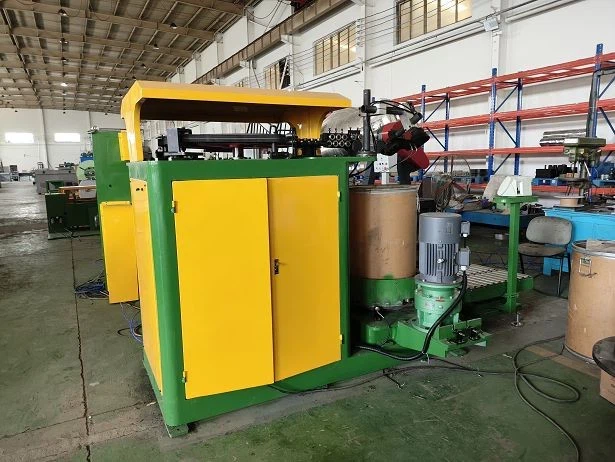
If you’re looking to upgrade your existing winding machinery or invest in a new system, we’re here to help. Our team can walk you through the best wire cutter options for your specific wire type, production volume, and facility needs, so you don’t have to deal with the headaches of bad cuts, downtime, or faulty spools. Reach out to our team to learn more about how we can tailor a solution to your operation.
Other Auxiliary Equipment References
- Welding Equipment Manufacturers Association. (2021). Best Practices for Welding Wire Processing and Packaging. National Institute for Welding Technology.
- Smith, J. (2019). Mechanical Components of Wire Winding Machinery. Industrial Press.
- Miller, T. (2020). Wire Quality and Welding Performance: The Impact of Packaging Processes. Journal of Manufacturing and Materials Processing.
- Global Industry Analysts. (2022). Welding Wire Market: Trends, Equipment Demand, and Operational Efficiency.
Three Water Machinery Co., Ltd.
Three Water Machinery Co., Ltd. is one of the most reliable manufacturers and suppliers of welding wire winding machinery in China. With abundant experience, we warmly welcome you to buy advanced equipment for sale here and get quotation from our factory. Contact us for more details.
Address: No.15, Jiaye Road, Liuanzhuang Industrial Park, Beichen District, Tianjin, China
E-mail: sales@eqet.com
WebSite: https://www.eqet.com/
